Category: Uncategorized

  • Trump admin axed 383 active clinical trials, dumping over 74K participants

    Trump admin axed 383 active clinical trials, dumping over 74K participants


    “A betrayal”

    Jena and colleagues examined the greater context, comparing the number of cancelled trials in each treatment category to the total number of all funded trials in those categories. For instance, while cancer trials made up 30 percent of the 383 cancelled trials, the 118 cancelled cancer trials accounted for only 2.7 percent of the total 4,424 cancer trials funded in the study period. The cancelled infectious disease trials, on the other hand, accounted for over 14 percent of all infectious disease trials funded (675). The categories most disproportionately affected were infectious diseases, respiratory diseases, and cardiovascular diseases.

    The researchers also looked at the purpose of the cancelled trials—for instance, for treatment of a disease, prevention, supportive care, or diagnostics. Of the 383, 140 were for treatments and 123 were for prevention.

    The authors note that they weren’t able to determine the stated reasons for the cancellations (if any) or compare this year’s trial cancellations to trends from previous years, which could offer more context to the cuts. There simply isn’t the same comprehensive data on clinical trial cancellations for past years, the authors said, noting “termination of federal grant funding was rare prior to 2025.”

    In the accompanying editor’s note, Teva Brender and Cary Gross blasted the revealed cancellations. To cancel trials already underway is to “squander participants’ and investigators’ valuable time, effort, and resources,” they write, since there have already been “substantive sunk costs.” It also “stifles scientific discovery and innovation.”

    But “there is a more direct and sobering impact of premature and scientifically unjustifiable trial terminations: the violation of foundational ethical principles of human participant research,” they write. “First and foremost, it is betrayal of the fundamental principles of informed consent for research.” And “participants who have been exposed to an intervention in the context of a trial may be harmed by its premature withdrawal or inadequate follow-up and monitoring for adverse effects.”

    Over 74,000 trial participants entrusted researchers with “their health and hope,” but even if the trial funding is restored—as it may be for some—it would “at best mitigate the harms.”


    Source link

  • Judge smacks down Texas AG’s request to immediately block Tylenol ads

    Judge smacks down Texas AG’s request to immediately block Tylenol ads


    A Texas Judge has rejected a request from Texas Attorney General Ken Paxton to issue a temporary order barring Tylenol’s maker, Kenvue, from claiming amid litigation that the pain and fever medication is safe for pregnant women and children, according to court documents.

    In records filed Friday, District Judge LeAnn Rafferty, in Panola County, also rejected Paxton’s unusual request to block Kenvue from distributing $400 million in dividends to shareholders later this month.

    The denials are early losses for Paxton in a politically charged case that hinges on the unproven claim that Tylenol causes autism and other disorders—a claim first introduced by President Trump and his anti-vaccine health secretary, Robert F. Kennedy Jr.

    In a bizarre press conference in September, Trump implored Americans repeatedly not to take the drug. But, scientific studies have not shown that Tylenol (acetaminophen) causes autism or other neurologic disorders. Some studies have claimed to find an association between Tylenol use and autism, but the studies have significant flaws, and others have found no link. Moreover, Tylenol is considered the safest pain and fever drug for use during pregnancy, and untreated pain and fevers in pregnancy are known to cause harms, including an increased risk of autism.

    Still, Paxton filed the lawsuit October 28, claiming that Kenvue and Tylenol’s former parent company, Johnson & Johnson, deceptively marketed Tylenol as safe while knowing of an increased risk of autism and other disorders. The lawsuit sought to force Kenvue to change the way it markets Tylenol and pay fines, among other requests.


    Source link

  • The evolution of rationality: How chimps process conflicting evidence

    The evolution of rationality: How chimps process conflicting evidence


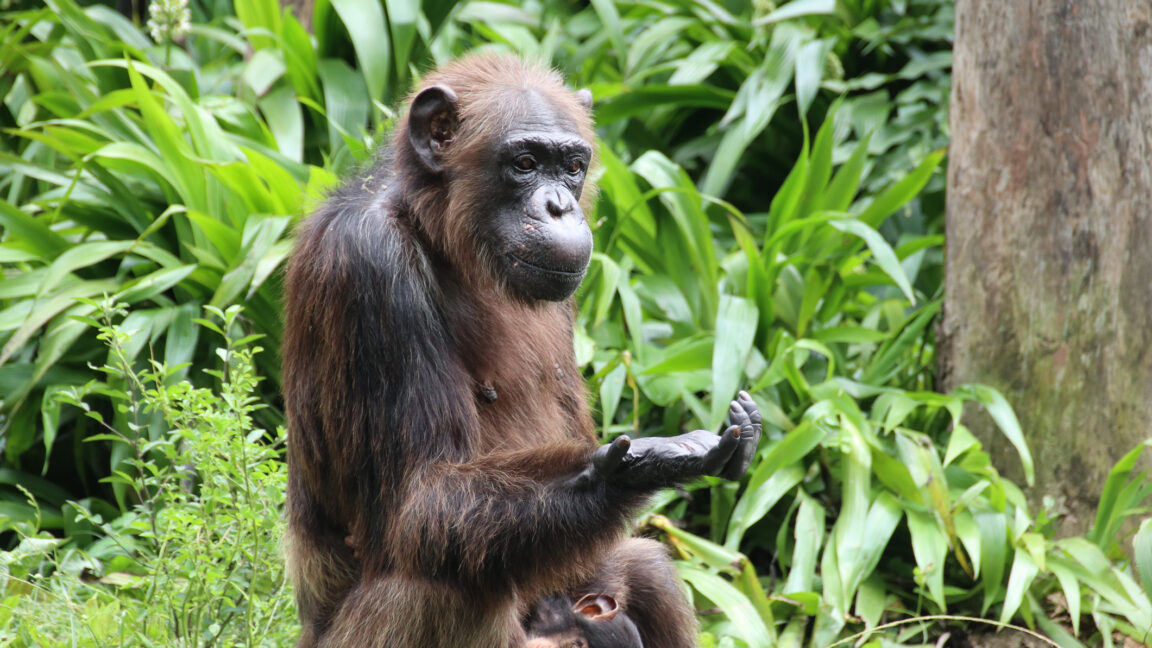
    In the first step, the chimps got the auditory evidence, the same rattling sound coming from the first container. Then, they received indirect visual evidence: a trail of peanuts leading to the second container. At this point, the chimpanzees picked the first container, presumably because they viewed the auditory evidence as stronger. But then the team would remove a rock from the first container. The piece of rock suggested that it was not food that was making the rattling sound. “At this point, a rational agent should conclude, ‘The evidence I followed is now defeated and I should go for the other option,’” Engelmann told Ars. “And that’s exactly what the chimpanzees did.”

    The team had 20 chimpanzees participating in all five experiments, and they followed the evidence significantly above chance level—in about 80 percent of the cases. “At the individual level, about 18 out of 20 chimpanzees followed this expected pattern,” Engelmann claims.

    He views this study as one of the first steps to learn how rationality evolved and when the first sparks of rational thought appeared in nature. “We’re doing a lot of research to answer exactly this question,” Engelmann says.

    The team thinks rationality is not an on/off switch; instead, different animals have different levels of rationality. “The first two experiments demonstrate a rudimentary form of rationality,” Engelmann says. “But experiments four and five are quite difficult and show a more advanced form of reflective rationality I expect only chimps and maybe bonobos to have.”

    In his view, though, humans are still at least one level above the chimps. “Many people say reflective rationality is the final stage, but I think you can go even further. What humans have is something I would call social rationality,” Engelmann claims. “We can discuss and comment on each other’s thinking and in that process make each other even more rational.”

    Sometimes, at least in humans, social interactions can also increase our irrationality instead. But chimps don’t seem to have this problem. Engelmann’s team is currently running a study focused on whether the choices chimps make are influenced by the choices of their fellow chimps. “The chimps only followed the other chimp’s decision when the other chimp had better evidence,” Engelmann says. “In this sense, chimps seem to be more rational than humans.”

    Science, 2025. DOI: 10.1126/science.aeb7565


    Source link

  • US may owe $1 trillion in refunds if SCOTUS cancels Trump tariffs

    US may owe $1 trillion in refunds if SCOTUS cancels Trump tariffs


    US may end up owing $1 trillion in refunds

    Economists urged SCOTUS to intervene and stop Trump’s attempt to seize authority to impose boundless reciprocal tariffs—arguing the economic impact “is predicted to be far greater than in two programs” SCOTUS previously struck, including the Biden administration’s $50 billion plan for student loan forgiveness.

    In September, Treasury Secretary Scott Bessent warned justices that “the amount to be refunded could be between $750 billion and $1 trillion if the court waits until next summer before issuing a ruling that says the tariffs have to be repaid,” CNBC reported.

    During oral arguments, Justice Amy Coney Barrett fretted that undoing Trump’s tariffs could be “messy,” CNBC reported.

    However, some business owners—who joined the We Pay Tariffs coalition weighing in on the SCOTUS case—told CNBC that they think it could be relatively straightforward, since customs forms contain line items detailing which tariffs were paid. Businesses could be paid in lump sums or even future credits, they suggested.

    Rick Muskat, CEO of family-run shoe company DeerStags, told CNBC that his company paid more than $1 million in tariffs so far, but “it should be simple for importers to apply for refunds based on this tariff itemization.” If the IRS can issue repayments for tax overpayments, US Customs should have “no problem” either, he suggested—especially since the agency automatically refunded US importers with no issue during a 2018 conflict, CNBC reported.

    If there aren’t automatic refunds, though, things could get sticky. Filing paperwork required to challenge various tariffs may become “time-consuming and difficult” for some businesses, particularly those dealing with large shipments where only some products may have been taxed.

    There’s also the issue that some countries’ tariffs—like China’s—changed “multiple times,” Joyce Adetutu, a partner at the law firm Vinson & Elkins, told CNBC. “It is going to take quite a bit of time untangling all of that, and it will be an administrative burden,” Adetutu said.


    Source link

  • Wyoming dinosaur mummies give us a new view of duck-billed species

    Wyoming dinosaur mummies give us a new view of duck-billed species


    As a result, the Edmontosaurus image got updated one more time. And some of the updates were rather striking.

    Delicate elephants

    Sereno’s team analyzed the newly discovered Edmontosaurus mummies with a barrage of modern imaging techniques like CT scans, X-rays, photogrammetry, and more. “We created a detailed model of the skin and wrapped it around the skeleton—some of these technologies were not even available 10 years ago,” Sereno says. The result was an updated Edmontosaurus image that includes changes to the crest, the spikes, and the appearance of its skin. Perhaps most surprisingly, it adds hooves to its legs.

    It turned out both Knight and Horner were partially right about the look of Edmontosaurus’ back. The fleshy crest, as depicted by Knight, indeed started at the top of the head and extended rearward along the spine. The difference was that there was a point where this crest changed into a row of spikes, as depicted in the Horner version. The spikes were similar to the ones found on modern chameleons, where each spike corresponds one-to-one with the vertebrae underneath it.

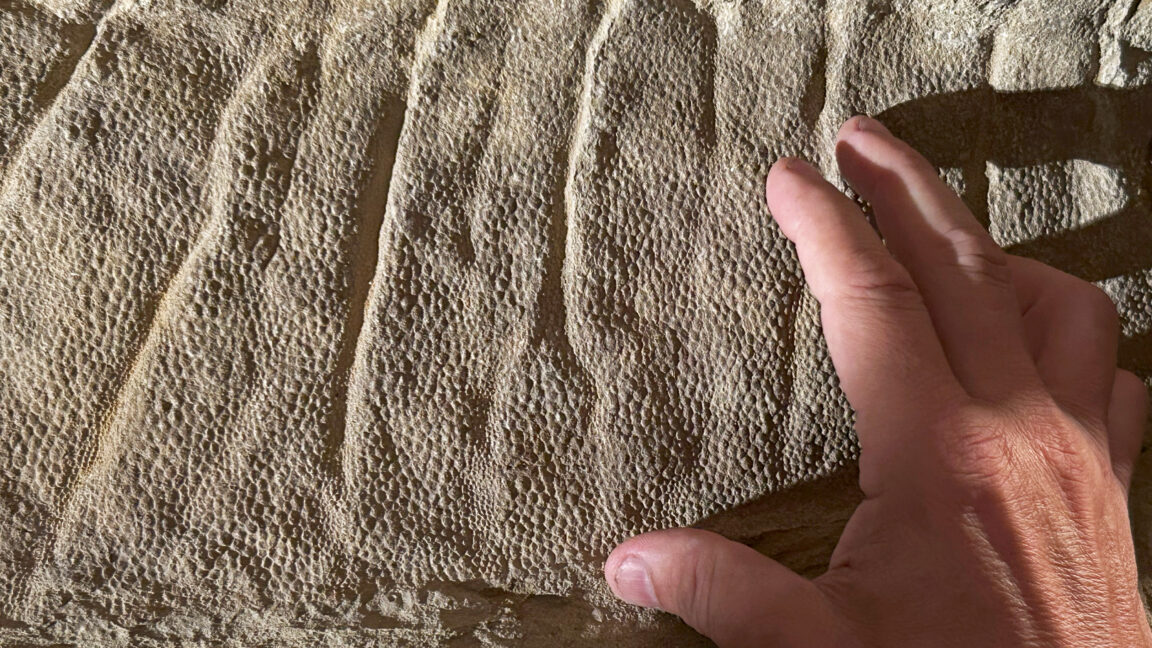
    “Another thing that was stunning in Edmontosaurus was the small size of its scales,” Sereno says. Most of the scales were just 1 to 4 millimeters across. They grew slightly larger toward the bottom of the tail, but even there they did not exceed 1 centimeter. “You can find such scales on a lizard, and we’re talking about an animal the size of an elephant,” Sereno adds. The skin covered with these super-tiny scales was also incredibly thin, which the team deduced from the wrinkles they found in their imagery.

    And then came the hooves. “In a hoof, the nail goes around the toe and wraps, wedge-shaped, around its bottom,” Sereno explains. The Edmontosaurus had singular, central hooves on its fore legs with a “frog,” a triangular, rubbery structure at the underside. “They looked very much like equine hooves, so apparently these were not invented by mammals,” Sereno says. “Dinosaurs had them.” The hind legs that supported most of the animal’s weight, on the other hand, had three wedge-shaped hooves wrapped around three digits and a fleshy heel toward the back—a structure found in modern-day rhinos.


    Source link

  • What’s it like to compete in the longest US off-road rally with no GPS?

    What’s it like to compete in the longest US off-road rally with no GPS?


    I’ve been involved with the Rebelle Rally since its inception in 2016, either as a competitor or live show host, and over the past 10 years, I’ve seen it evolve from a scrappy rally with big dreams to the world-class event that it is today.

    In a nutshell, the Rebelle Rally is the longest competitive off-road rally in the United States, covering over 2,000 kilometers, and it just happens to be for women. Over eight days, teams of two must plot coordinates on a map, figure out their route, and find multiple checkpoints—both marked and unmarked—with no GPS, cell phones, or chase crews. It is not a race for speed but rather a rally for navigational accuracy over some of the toughest terrain California and Nevada have to offer. There are two classes: 4×4 with vehicles like the Jeep Wrangler and Ford Bronco and X-Cross for cars like the Honda Passport and BMW X5. Heavy modifications aren’t needed, and many teams compete for the coveted Bone Stock award.

    For this 10th anniversary, I got back behind the wheel of a 2025 Subaru Crosstrek Wilderness as a driver, with Kendra Miller as my navigator, to defend my multiple podium finishes and stage wins and get reacquainted with the technology, or lack thereof, that makes this multi-day competition so special.

    Technology powers the Rebelle Rally, except for when it comes to the competitors’ navigation.

    Nicole Dreon

    Does this rally run actually on tater tots?

    Nicole Dreon

    High-tech rally

    In the morning, as Kendra uses a scale ruler to plot 20-plus coordinates on the map of the day, a laborious task that requires intense concentration, I have time to marvel at base camp a bit. We climb out of our snuggy sleeping bags and tents in the pitch black of 5 am, but the main tent is brighter than ever thanks to Renewable Innovations and its mobile microgrid.

    This system combines a solar and a hydrogen fuel cell system for up to 750 kWh of power. In the early morning, the multiple batteries in both systems power the bright lights that the navigators need to see their maps, and the Starlink units send the commentary show to YouTube and Facebook Live. Competitors and staff can take a hot shower, the kitchen fries up the morning’s tater tots—seriously, they are the best—and the day’s drivers’ meeting gets started on the PA system. We’re 100 miles from nowhere, and it feels like home.


    Source link

  • What would a “simplified” Starship plan for the Moon actually look like?

    What would a “simplified” Starship plan for the Moon actually look like?


    Using an optimized, expendable Starship might reduce the number of tanker missions required by up to 50 percent. There are downsides, including a significant increase in costs and an undermining of the whole point of Starship: full and rapid reuse.

    It is safe to say that Starship will be the largest human spacecraft to land on the Moon by far.

    Credit:
    SpaceX

    It is safe to say that Starship will be the largest human spacecraft to land on the Moon by far.


    Credit:

    SpaceX

    There is a third downside, and this is perhaps the most important one. An “expendable” Starship plan would be anathema to the leadership of SpaceX, including founder Elon Musk. Officials there do not believe the space industry has fully digested how Starship will transform the launch industry.

    “You don’t yet understand how many Starship launches will happen,” a senior SpaceX source told Ars.

    The company is aiming to launch 1 million tons of payload to orbit per year, the majority of which will be propellant. SpaceX simply believes that once it locks in on Starship operations, launching a dozen or many more rockets per month won’t be a big deal. So why waste time on expendable rockets? That era is over.

    Enter the Dragon

    A second option would be to rely solely on SpaceX hardware.

    I don’t expect NASA to be interested in this idea, but it’s worth discussing. Nearly a year ago, in the immediate aftermath of the presidential election, Republican space officials were considering canceling Artemis and substituting a “competition” similar to the Commercial Cargo program. It was thought that both SpaceX and Blue Origin would bid plans to land humans on the Moon and that NASA would fund both.

    These plans have largely fallen by the wayside in the last 12 months, though. NASA (and perhaps most importantly, paymasters in Congress) prefer to stick with the Space Launch System rocket and Orion spacecraft for the initial Artemis missions.

    But if pressed, SpaceX could come up with a simplified Moon landing architecture that requires fewer refuelings. There are multiple ways this could be done, so I’ll offer just one variant here:


    Source link

  • OpenAI walks a tricky tightrope with GPT-5.1’s eight new personalities

    OpenAI walks a tricky tightrope with GPT-5.1’s eight new personalities


    On Wednesday, OpenAI released GPT-5.1 Instant and GPT-5.1 Thinking, two updated versions of its flagship AI models now available in ChatGPT. The company is wrapping the models in the language of anthropomorphism, claiming that they’re warmer, more conversational, and better at following instructions.

    The release follows complaints earlier this year that its previous models were excessively cheerful and sycophantic, along with an opposing controversy among users over how OpenAI modified the default GPT-5 output style after several suicide lawsuits.

    The company now faces intense scrutiny from lawyers and regulators that could threaten its future operations. In that kind of environment, it’s difficult to just release a new AI model, throw out a few stats, and move on like the company could even a year ago. But here are the basics: The new GPT-5.1 Instant model will serve as ChatGPT’s faster default option for most tasks, while GPT-5.1 Thinking is a simulated reasoning model that attempts to handle more complex problem-solving tasks.

    OpenAI claims that both models perform better on technical benchmarks such as math and coding evaluations (including AIME 2025 and Codeforces) than GPT-5, which was released in August.

    Improved benchmarks may win over some users, but the biggest change with GPT-5.1 is in its presentation. OpenAI says it heard from users that they wanted AI models to simulate different communication styles depending on the task, so the company is offering eight preset options, including Professional, Friendly, Candid, Quirky, Efficient, Cynical, and Nerdy, alongside a Default setting.

    These presets alter the instructions fed into each prompt to simulate different personality styles, but the underlying model capabilities remain the same across all settings.

    An illustration showing GPT-5.1’s eight personality styles in ChatGPT.


    Credit:

    OpenAI


    In addition, the company trained GPT-5.1 Instant to use “adaptive reasoning,” meaning that the model decides when to spend more computational time processing a prompt before generating output.

    The company plans to roll out the models gradually over the next few days, starting with paid subscribers before expanding to free users. OpenAI plans to bring both GPT-5.1 Instant and GPT-5.1 Thinking to its API later this week. GPT-5.1 Instant will appear as gpt-5.1-chat-latest, and GPT-5.1 Thinking will be released as GPT-5.1 in the API, both with adaptive reasoning enabled. The older GPT-5 models will remain available in ChatGPT under the legacy models dropdown for paid subscribers for three months.


    Source link

  • Microsoft releases update-fixing update for update-eligible Windows 10 PCs

    Microsoft releases update-fixing update for update-eligible Windows 10 PCs


    Officially, Windows 10 died last month, a little over a decade after its initial release. But the old operating system’s enduring popularity has prompted Microsoft to promise between one and three years of Extended Security Updates (ESUs) for many Windows 10 PCs. For individuals with Windows 10 PCs, it’s relatively easy to get an additional year of updates at no cost.

    Or at least, it’s supposed to be. Bugs initially identified by Windows Latest were keeping some Windows 10 PCs from successfully enrolling in the ESU program, preventing those PCs from signing up to grab the free updates. And because each Windows 10 PC has to be manually enrolled in the program, a broken enrollment process also meant broken security updates.

    To fix the problems, Microsoft released an update for Windows 10 22H2 (KB5071959) this week that both acknowledges and fixes an issue “where the enrollment wizard may fail during enrollment.” It’s being offered to all Windows 10 PCs regardless of whether they’re enrolled in the ESU program “as it resolves an issue that was preventing affected customers from receiving essential security updates.”


    Source link

  • Google vows to stop scam E-Z Pass and USPS texts plaguing Americans

    Google vows to stop scam E-Z Pass and USPS texts plaguing Americans


    Cracking down on the broad enterprise will be tough, Google anticipates, with its complaint only referencing online aliases and naming a range of John Doe plaintiffs. But identities of all actors in the enterprise—including software developers, data brokers, spammers, thieves, and administrators—must be uncovered to stop the criminal gang from continuing to provide so-called phishing-as-a-service.

    “Who is fishing? Looking for a partner.”

    The Lighthouse enterprise today mainly coordinates attacks on several Telegram channels, Google alleged, since the tech giant suspended a YouTube channel associated with the criminal activity.

    On Telegram, members of the criminal network can “purchase the software, learn how to create various phishing attacks, and, upon purchase, meet the other members of the Enterprise,” Google claimed.

    One Telegram channel has over 2,500 members, Google’s filing said. On that channel, members can connect with others who have certain specialties, with users making requests like “Who can send a few US live baits?” or “Who is fishing? Looking for a partner.” Others seek help selling stolen credentials, like one user who posted, “selling pure handmade wealthy accounts with Zel[le] activation, telegraphic transfer accounts, Apple CASH ID, those who understand, come.”

    Google monitors Telegram and has spent “hundreds of hours investigating and remediating” Lighthouse scams, the complaint said, and the tech giant now expects that a lawsuit could finally stop the well-known schemes from spreading. Otherwise, Google and countless others will continue suffering “irreparable harm,” the complaint said.

    Damages are not specified in the complaint, which accused the Lighthouse enterprise of committing wire fraud and violating the Racketeer Influenced and Corrupt Organizations Act, the Lanham Act, and the Computer Fraud and Abuse Act, among other allegations.

    If Google wins, the phishing scams may finally slow, ending the days of Americans squinting at their phones to figure out if they ordered a package or forgot to pay a toll.

    “Google’s historic lawsuit marks the first time a company has taken action to curb these scams and dismantle this criminal enterprise,” Google said, vowing to “disrupt the criminal enterprise behind this scheme and stop its spread.”


    Source link