Category: Uncategorized

  • US states could lose $21 billion of broadband grants after Trump overhaul

    US states could lose $21 billion of broadband grants after Trump overhaul


    The BEAD law is clear that the money can be used for more than sending subsidies to Internet service providers. The law says BEAD money can be allocated for connecting eligible community anchor institutions; data collection, broadband mapping, and planning; installing Internet and Wi-Fi infrastructure or providing reduced-cost broadband to multi-family buildings; and providing affordable Internet-capable devices.

    The current law also says that if a state fails to use its full allocation, the National Telecommunications and Information Administration (NTIA) “shall reallocate the unused amounts to other eligible entities with approved final proposals.” The law gives the NTIA chief latitude to spend the money for “any use determined necessary… to facilitate the goals of the Program.”

    Arielle Roth, who has overseen the BEAD overhaul in her role as head of the NTIA, has said she’s open to sending the remaining funds to states. Roth said in an October 28 speech that the NTIA is “considering how states can use some of the BEAD savings—what has commonly been referred to as nondeployment money—on key outcomes like permitting reform” but added that “no final decisions have been made.” The Ernst bill would take that decision out of the NTIA’s hands.

    States still waiting after Biden plans thrown out

    After Congress created BEAD, the Biden administration spent about three years developing rules and procedures for the program and then evaluating plans submitted by each US state and territory. The process included developing new maps that, while error-prone due to false submissions by ISPs, provided a more accurate view of broadband coverage gaps than was previously available.

    By November 2024, the Biden administration had approved initial funding plans submitted by every state and territory. But the Trump administration rewrote the program rules, eliminating a preference for fiber and demanding lower-cost deployments.

    States that could have started construction in summer 2025 had to draft new plans and keep waiting for the grant money. The Trump administration is also telling states that they must exempt ISPs from net neutrality and price laws in order to obtain grant funding.

    As for when the long-delayed grants will be distributed, Roth said the NTIA is “on track to approve the majority of state plans and get money out the door this year.”


    Source link

  • Neutron rocket’s debut slips into mid-2026 as company seeks success from the start

    Neutron rocket’s debut slips into mid-2026 as company seeks success from the start


    During an earnings call on Monday, Rocket Lab chief executive Pete Beck announced that the company’s medium-lift launch vehicle, Neutron, would not launch this year.

    For anyone with the slightest understanding of the challenges involved in bringing a new rocket to the launch pad, as well as a calendar, the delay does not come as a surprise. Although Rocket Lab had been holding on to the possibility of launching Neutron this year publicly, it has been clear for months that a slip into 2026 was inevitable.

    According to Beck, speaking during a third-quarter 2025 earnings call, the new timeline has the company bringing Neutron to Launch Complex 2 at Wallops Flight Facility in Virginia during the first quarter of next year. The first launch is scheduled to occur “thereafter,” according to the company’s plans.

    The Rocket Lab way

    As part of his remarks, Beck said Rocket Lab would not be rushed by an arbitrary deadline.

    “We’ve seen what happens when others rush to the pad with an unproven product, and we just refused to do that,” he said, referring to other commercial launch companies that have not had success with their first launches. “Our aim is to make it to orbit on the first try. You won’t see us using some qualifier about us just clearing the pad, and claiming success and whatnot, and that means that we don’t want to learn something during Neutron’s first flight that could be learned on the ground during the testing phase.”

    Through the development of the smaller Electron rocket as well as various satellites and in-space vehicles, Rocket Lab has followed and honed a process that breeds success in flight, Beck said. Right now, Rocket Lab is in a “meaty” testing process when components of the vehicle are being assembled for the first time, Beck added.

    Rocket Lab has reached the “meaty” part of the testing process.

    Credit:
    Rocket Lab

    Rocket Lab has reached the “meaty” part of the testing process.


    Credit:

    Rocket Lab

    “This is a time when you find out on the ground what you got right, and what you got wrong, rather than finding out that during first launch,” he said. “Now at Rocket Lab, we have a proven process for delivering and developing complex space flight hardware, and I think that process speaks for itself with respect to our hardware, always looking beautiful, and, more importantly, always working beautifully. Now, our process is meticulous, but it works.”


    Source link

  • Apple TV execs dismiss introducing an ad tier, buying Warner Bros. Discovery

    Apple TV execs dismiss introducing an ad tier, buying Warner Bros. Discovery


    Focused on original content

    Another obvious way to grow Apple TV is through more subscribers. With talk of Warner Bros. Discovery considering a sale, it’s worth wondering if Apple TV may try to grow through acquisition. But the execs Screen International spoke with seemed focused on building out Apple TV’s library with originals. Cue noted that “at least in the timeframe that we’re thinking about right now, we’re not looking at licensing any content or adding anything to our service.”

    “We’re building an all-original services; we’re not building on the back of pre-existing IP or library,” Jamie Erlicht, one of Apple’s heads of worldwide video, said.

    More directly, when asked if Apple might buy Warner Bros., A24, or Disney, Cue pointed out that Apple hasn’t historically done “a lot of major acquisitions.”

    “We do very small acquisitions in general, not related to Apple TV, so I don’t see that happening because we like what we’re doing,” Cue said.

    Since its 2019 debut, some have questioned whether Apple TV is an authentic attempt to improve streaming options for customers, or if Apple TV is a “vanity project,” as Screen International put it, or if the service is merely a tool for getting people to buy other Apple products. Naturally, the interviewed executives claimed that the service is built on a commitment to distributing unique and premium shows and movies.

    The interview provided more insight into how Apple TV leadership defines the latter. Zack Van Amburg, one of Apple’s heads of worldwide video, said:

    A core tenet of everything Apple does is the notion that humanity needs to be at the center of it, and that’s everything from app design to hardware engineering, to everything in between. We try to think a little more deeply about that.

    Our shows and our movies tend to be about the emotional experience, the stakes involved, even when we’re doing a comedy.


    Source link

  • Higher prices, simpler streaming expected if HBO Max folds into Paramount+

    Higher prices, simpler streaming expected if HBO Max folds into Paramount+


    If a company acquires any form of HBO, one of its top challenges is expected to be streamlining operations while maintaining HBO’s premium brand. This could be especially difficult under a “more mainstream umbrella like Paramount+,” Alderman noted.

    Streaming has already diluted the HBO brand somewhat. Through streaming, HBO is now associated with stuff from DC Comics and Cartoon Network, as well as reality shows, like 90 Day Fiancé and Naked and Afraid. Merging with Paramount+ or even Netflix could expand the HBO umbrella further.

    That expanded umbrella could allow a company like Paramount to better compete against Netflix, something WBD executives have shied away from. HBO Max is “not everything for everyone in a household,” JB Perrette, WBD’s streaming president and CEO, said this spring.

    “What people want from us in a world where they’ve got Netflix and Amazon [Prime Video] are those things that differentiate us,” Casey Bloys, chairman and CEO of HBO and Max content, told The Wall Street Journal in May.

    A “stress test” for more streaming mergers

    Aside from the impact on HBO Max subscribers, WBD’s merger talks have broad implications. A deal would open the door for much more consolidation in the streaming space, something that experts have been anticipating for some years and that addresses the boom of streaming services. Per Clark, discussions of a Paramount-WBD merger are “less about two studios joining forces and more about a stress test for future M&A.”

    If WBD accepts a Paramount bid and that bid clears regulatory hurdles, it would signal that “premium content under fewer umbrellas is back in play,” Clark said.

    A Paramount-WBD merger is likely to speed up consolidation among mid-tier players, like NBCUniversal, Lionsgate, and AMC, Alderman said, pointing to these companies’ interest in scaling their streaming businesses and in building differentiated portfolios to counter Netflix and Disney+’s expansive libraries.

    If Paramount and WBD don’t merge, Clark expects to see more “piecemeal” strategies, such as rights-sharing, joint venture bundles, and streaming-as-a-service models.


    Source link

  • Here’s how orbital dynamics wizardry helped save NASA’s next Mars mission

    Here’s how orbital dynamics wizardry helped save NASA’s next Mars mission


    Blue Origin scrubbed Sunday’s launch attempt due to poor weather, a cruise ship in restricted waters near the launch site, and ground system issues. The company says the next available launch opportunity is Wednesday, November 12, with a window opening at 2:50 pm EST (19:50 UTC).

    CAPE CANAVERAL, FloridaThe field of astrodynamics isn’t a magical discipline, but sometimes it seems trajectory analysts can pull a solution out of a hat.

    That’s what it took to save NASA’s ESCAPADE mission from a lengthy delay, and possible cancellation, after its rocket wasn’t ready to send it toward Mars during its appointed launch window last year. ESCAPADE, short for Escape and Plasma Acceleration and Dynamics Explorers, consists of two identical spacecraft setting off for the red planet as soon as Sunday with a launch aboard Blue Origin’s massive New Glenn rocket.

    “ESCAPADE is pursuing a very unusual trajectory in getting to Mars,” said Rob Lillis, the mission’s principal investigator from the University of California, Berkeley. “We’re launching outside the typical Hohmann transfer windows, which occur every 25 or 26 months. We are using a very flexible mission design approach where we go into a loiter orbit around Earth in order to sort of wait until Earth and Mars are lined up correctly in November of next year to go to Mars.”

    This wasn’t the original plan. When it was first designed, ESCAPADE was supposed to take a direct course from Earth to Mars, a transit that typically takes six to nine months. But ESCAPADE will now depart the Earth when Mars is more than 220 million miles away, on the opposite side of the Solar System.

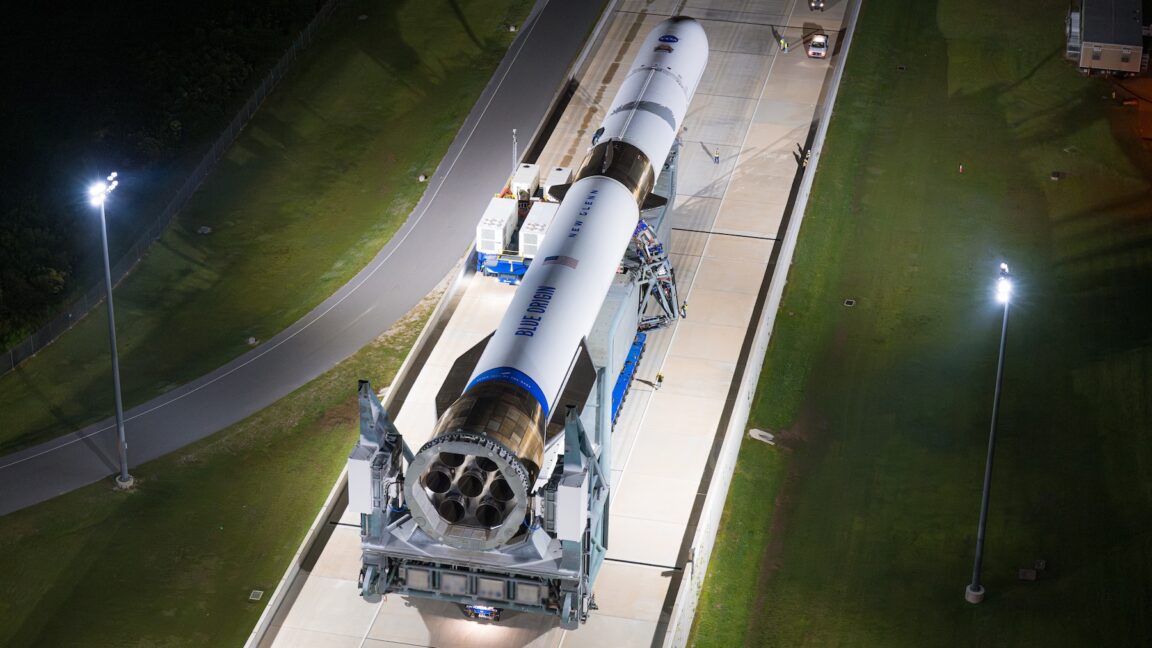
    The payload fairing of Blue Origin’s New Glenn rocket, containing NASA’s two Mars-bound science probes.


    Credit:

    Blue Origin

    The most recent Mars launch window was last year, and the next one doesn’t come until the end of 2026. The planets are not currently in alignment, and the proverbial stars didn’t align to get the ESCAPADE satellites and their New Glenn rocket to the launch pad until this weekend.

    This is fine

    But there are several reasons this is perfectly OK to NASA. The New Glenn rocket is overkill for this mission. The two-stage launcher could send many tons of cargo to Mars, but NASA is only asking it to dispatch about a ton of payload, comprising a pair of identical science probes designed to study how the planet’s upper atmosphere interacts with the solar wind.

    But NASA got a good deal from Blue Origin. The space agency is paying Jeff Bezos’ space company about $20 million for the launch, less than it would for a dedicated launch on any other rocket capable of sending the ESCAPADE mission to Mars. In exchange, NASA is accepting a greater than usual chance of a launch failure. This is, after all, just the second flight of the 321-foot-tall (98-meter) New Glenn rocket, which hasn’t yet been certified by NASA or the US Space Force.


    Source link

  • The government shutdown is starting to have cosmic consequences

    The government shutdown is starting to have cosmic consequences


    The federal government shutdown, now in its 38th day, prompted the Federal Aviation Administration to issue a temporary emergency order Thursday prohibiting commercial rocket launches from occurring during “peak hours” of air traffic.

    The FAA also directed commercial airlines to reduce domestic flights from 40 “high impact airports” across the country in a phased approach beginning Friday. The agency said the order from the FAA’s administrator, Bryan Bedford, is aimed at addressing “safety risks and delays presented by air traffic controller staffing constraints caused by the continued lapse in appropriations.”

    The government considers air traffic controllers essential workers, so they remain on the job without pay until Congress passes a federal budget and President Donald Trump signs it into law. The shutdown’s effects, which affected federal workers most severely at first, are now rippling across the broader economy.

    Sharing the airspace

    Vehicles traveling to and from space share the skies with aircraft, requiring close coordination with air traffic controllers to clear airspace for rocket launches and reentries. The FAA said its order restricting commercial air traffic, launches, and reentries is intended to “ensure the safety of aircraft and the efficiency of the [National Airspace System].”

    In a statement explaining the order, the FAA said the air traffic control system is “stressed” due to the shutdown.

    “With continued delays and unpredictable staffing shortages, which are driving fatigue, risk is further increasing, and the FAA is concerned with the system’s ability to maintain the current volume of operations,” the regulator said. “Accordingly, the FAA has determined additional mitigation is necessary.”

    Beginning Monday, the FAA said commercial space launches will only be permitted between 10 pm and 6 am local time, when the national airspace is most calm. The order restricts commercial reentries to the same overnight timeframe. The FAA licenses all commercial launches and reentries.


    Source link